

Agent Skills
Agents run expert workflows and follow SOPs for reliable hospitality operations.
Stop feeling overwhelmed by inconsistent, unskilled execution. Free your team and reduce errors with 10–15X ROI, without adding headcount.



When Execution Breaks Down

Meet Laura, General Manager.
In Operations, she sees the same pattern repeat: guest communication, task prioritization, and decision-making vary depending on who is on shift. Even with a trained team, busy days lead to shortcuts, mistakes, and slipping standards.
Marketing, revenue, and legal decisions add another layer of uncertainty. Expertise often sits outside the hotel, leaving Laura unsure if the right calls are being made or if money is being left on the table.
Internally, it’s draining. Laura spends more time compensating for manual work than being an amazing host for her guests. And at a deeper level, it feels wrong: if workflows are predictable and experts know the right way, why does execution still rely so heavily on manual effort?
Most GMs want reliable execution and expert decisions, but face limited capacity, missing specialization, or inconsistent quality every day.
Where Expertise Becomes Execution
With Skills, Laura’s team turns expertise into AI-executed workflows that run alongside them.
Instead of relying on memory and manual coordination, agents follow proven SOPs like experienced operators, consistently and on time.
In Operations: Guest communication, task prioritization, and routine execution happen the same way every day, even on busy shifts. Standards no longer depend on who is on duty. Laura’s team stays in control and execution becomes reliable.
In Marketing, Revenue, and Legal: Daily decisions are guided by expert workflows. Routine tasks and decisions are handled confidently and on time.
Laura adopts Skills one workflow at a time. Her team can use default workflows (such as the free SOP Quality Assessment), customize them through familiar SOPs, or layer in consultants’ guidance. Teams stay involved while agents handle the execution.
The result is more capacity, consistency, and better decisions, without adding headcount or tools.

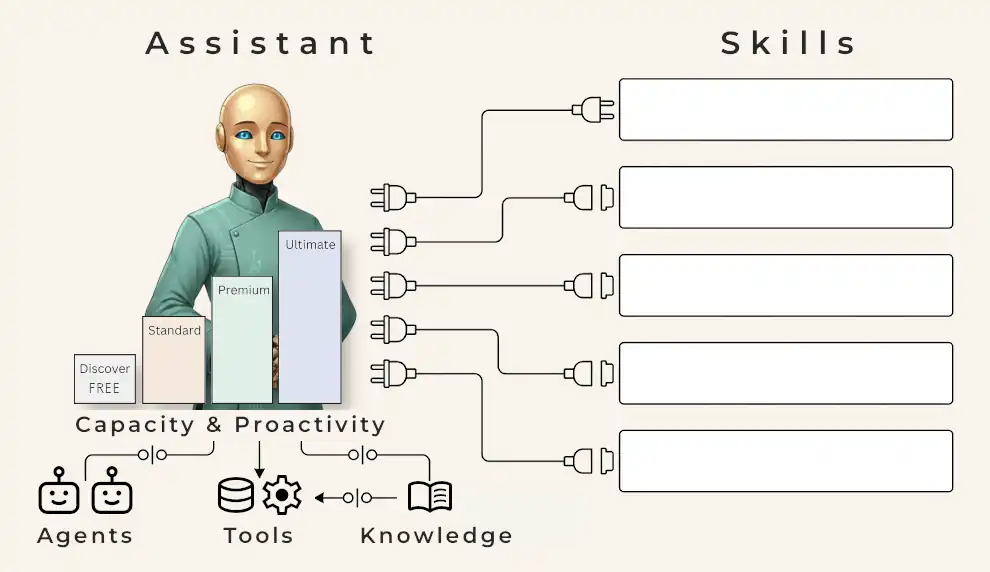
Assistants and Skills: How they click together
Think of an Assistant like a new hire. It arrives knowing hospitality best practices, but the real value kicks in when you walk it through your property. You teach it your objectives, policies, and procedures once, and it applies that knowledge across every task. "Skills" are just the specific jobs you hand off to it.
This architecture offers three major advantages:
- Reduced Costs: Stop paying multiple vendors for duplicate overhead. You pay for one core infrastructure (assistants) and only add the specific value-adds you need (skills), reducing total technology costs by around 3×.
- Unified Data: There is only one place to train all your AI agents. You never have to update the same info in three places or jump between five different systems.
- Flexibility: You can easily introduce your own skill or have a partner develop one for you. You tailor the technology to your operations with minimal overhead.

How to get started with Skills
Adopt Skills gradually, starting small and expanding as value becomes clear.
Start with simple, low-risk Skills, such as advanced prompts or basic workflows from the catalog, contributed by inHotel and our industry expert partners, to see immediate value.
Identify gaps and transition more complex workflows to expert-defined agentic execution, such as overbooking handling. Optionally connect agents to your systems to support data-informed decisions.
Adapt defaults to your environment through SOPs. Monitor outcomes, collect feedback, and continually refine workflows as teams grow comfortable and operations evolve.
Skills and Tools: What’s the Difference?
Skills define how work gets done. For example, checking in a guest, creating a restaurant menu, or onboarding an employee.
Tools define where work happens, such as the PMS, email, or a custom app.
Skills are independent of the software used, so your team can follow the same standards even if tools change. As a result, operators can:

Change or upgrade systems with significantly less disruption

Apply the same standards across different properties and tech stacks

Let agents collaborate across tools without rebuilding workflows
Why Skills Make Sense
Pay for value
Pay only for advanced prompts or workflows that deliver measurable ROI, based on transparent assumptions you can validate.
You stay in control
Skills follow your standards, and expert-defined workflows can be adjusted through your SOPs.
Adopt at your pace
Introduce Skills one workflow at a time, letting teams adjust gradually without disruption to daily operations.
Expertise on demand
Access expert-defined prompts and workflows that bring scarce expertise into daily operations, without needing specialists present day to day.
Efficient design
Skills are lightweight add-ons using the same assistants and information, reducing complexity and cost compared to stand-alone AI tools.
Pricing
Skills are priced individually, with flexible options for adoption and development.
1. Skill acquisition
Skills extend an assistant’s core capabilities. All inHotel Assistants, including the free Discover plan, can acquire Skills. Higher-tier plans let assistants handle more Skills of greater complexity, so you can expand capabilities as your needs grow.
Skills are published by inHotel or by inHotel-trained hospitality consultants. Skills can be free or paid, with paid Skills priced by subscription. Every paid Skill includes an ROI calculator so you can model value in your own environment. inHotel encourages Skill publishers to target ≥10X ROI.
2. Skill development
You can publish an advanced prompt or build a full workflow with inHotel’s help, turn it into a Skill for your own organization, or make it available to others across the industry. Learn more at Build Agent Skills.

This is a smart way to turn familiar workflows into a financial investment in AI.
3. Skill deployment
You can choose a deployment option tailored to your specific requirements.
All hosting and support fees are included in the published Skill price.
Exclusively available for assistants on Ultimate plans.
To integrate with inHotel’s Core Agentic Infrastructure, a small 2% share of the imputed economic value applies, supporting ongoing discoverability, access control, compatibility, and quality evaluations that protect your investment.
Frequently Asked Questions
How can hotels use AI to improve operational consistency without hiring more staff?
AI can improve operational consistency by executing workflows the same way every time, regardless of who is on shift. Instead of relying on memory or manual coordination, AI agents can prioritize tasks and follow defined SOPs. inHotel’s solution does this through Skills, which turn expert prompts and workflows into repeatable AI execution. Teams stay involved, but the AI handles the execution reliably, even on busy days. This reduces errors, limits shortcuts, and frees managers to focus on guests rather than constant supervision, all without increasing headcount.
What type of AI solution works best for hotel operations rather than generic AI tools?
Hotels benefit most from AI that is built specifically around hospitality workflows and SOPs, not generic chatbots or productivity tools. Generic AI often creates more work by requiring staff to adapt processes around the tool. inHotel’s approach is hospitality first. Its AI assistants run Skills that reflect real hotel operations, such as operational checks, marketing decisions, or revenue workflows. Skills are independent of software systems, so hotels can maintain consistent standards even when tools or systems change.
Can hotels adopt AI gradually instead of forcing big changes on their teams?
Yes. A gradual approach helps teams adapt to AI without feeling overwhelmed or resistant to change. inHotel’s solution is designed to be introduced one workflow at a time, allowing staff to build confidence and trust as they go. Teams can start with simple, low risk Skills such as SOP quality assessments or guided prompts, then expand into more advanced workflows once they are comfortable. This keeps daily operations familiar, reduces disruption, and allows managers to reinforce standards while the team learns to work alongside AI rather than feeling replaced by it.
How does AI reduce mistakes and burnout in hotel teams?
Mistakes and burnout often come from manual coordination, inconsistent execution, and decision fatigue. AI reduces this by taking over repeatable workflows and routine decisions. With inHotel’s Skills, AI agents execute tasks consistently and on time, following proven SOPs. This removes pressure from staff to remember everything during busy shifts and reduces the need for managers to constantly intervene. The result is fewer errors, more predictable outcomes, and teams that feel supported rather than stretched.
How is an AI workflow different from traditional hotel software tools?
Traditional hotel software focuses on where work happens, such as the PMS, email, or task management apps, but it still relies on people to execute the work correctly. AI workflows focus on how work gets done and can actively carry out steps on behalf of the team. inHotel’s Skills define the logic, standards, and decision making behind tasks and allow AI agents to execute workflows consistently, not just document or track them. This means operational standards no longer depend entirely on individual staff members and remain consistent even if tools change or teams rotate.
How can hotels avoid adding more complexity with multiple stand-alone AI tools?
Adding multiple AI tools often increases complexity, training effort, and cost. It also creates duplication of knowledge, since each tool needs to be trained on the hotel’s setup, standards, and team context. This quickly becomes overwhelming for staff to maintain and often leads to information getting out of sync. inHotel avoids this by using a single assistant that can run multiple Skills, all sharing the same context and knowledge. Instead of separate AI tools for operations, marketing, or revenue, hotels layer Skills onto existing assistants. This reduces duplication, keeps information consistent, and makes it easier for teams to work with AI without feeling overloaded.
How can hotels measure ROI before committing to paid AI workflows?
Hotels should be able to validate value before purchasing or scaling any AI solution. inHotel addresses this by pricing Skills individually and requiring Skill publishers to attach ROI calculators to all paid Skills. Publishers are encouraged to design Skills that target high returns for hoteliers, typically around 10X ROI. These calculators let operators model assumptions based on their own environment, such as time saved, error reduction, or revenue impact. This transparency helps owners make informed decisions and ensures AI investments are tied to measurable outcomes rather than vague promises.
How can hotel consultants or advisors distribute their expertise using AI?
Hospitality advisors can turn their repeatable expertise into AI prompts or workflows that hotels can use at scale. inHotel allows consultants to publish their prompts and workflows as Skills that can be reused across teams and properties. These Skills can be offered as subscriptions, enabling advisors to monetize their expertise while ensuring consistent execution for clients. Hotels benefit by accessing expert guidance directly within daily operations, without relying on ongoing consulting hours or constant human involvement.
What are the best ways for consultants to distribute AI prompts to hotel clients at scale?
Consultants typically share AI prompts through documents, templates, or custom GPTs, but these approaches are static and difficult to personalize across multiple hotels. inHotel offers a more scalable option by allowing consultants to distribute dynamic prompts as Skills. These prompts can include variables such as a hotel’s location, brand positioning, business objectives, or even the role and job description of the AI agent executing the task. This makes each execution context aware without rewriting the prompt. As a result, consultants can deliver highly customized guidance to many hotels at once, while maintaining consistency and reducing manual effort compared to static GPT-based solutions.
Is AI suitable for decision making in areas like revenue, marketing, or compliance?
AI is particularly effective for structured, repeatable decisions when guided by real industry expertise. inHotel’s Skills bring expert logic into daily decision making for areas such as revenue management, marketing actions, or legal reviews, based on workflows contributed by both hotel appointed consultants and vetted hospitality experts. This expertise is not averaged out across the internet like general AI models. It reflects real, local industry knowledge. AI handles routine decisions consistently and on time, while humans retain oversight and control. This ensures decisions stay aligned with proven practices, even when in house specialization is limited.
What is the most cost effective way for small or independent hotels to use AI?
For small or independent hotels, the most cost effective approach is to pay only for AI capabilities that deliver real value. inHotel enables this by offering Skills individually, including free and low cost options, and allowing gradual adoption. Hotels avoid large platform fees, unnecessary features, or long implementations. By starting small and expanding only where value is proven, even smaller operators can benefit from AI without taking on financial risk.
Is there a catalog of AI agent skills specifically for travel and hospitality?
Yes. inHotel offers a dedicated catalog of AI agent Skills built specifically for travel and hospitality use cases. The catalog includes advanced prompts, agentic workflows, and execution logic designed for hotels, restaurants, tour operators, experience providers, car rental agencies, golf courses, and wellness and spa operators. Skills are contributed by inHotel and by industry professionals and consultants, ensuring they reflect real world practices rather than generic AI scenarios. Travel and hospitality operators can browse, test, and adopt Skills individually, allowing them to build agent based capabilities gradually without committing to a large platform overhaul.
How can hotels reduce dependency on vendor software?
Hotels often become locked into vendor software because their processes are embedded inside specific systems. AI Agent Skills separate how work gets done from where it happens. With inHotel’s solution, Skills define the logic, standards, and execution of workflows independently from tools like the PMS or email. This allows hotels to change or upgrade systems without rebuilding processes or retraining teams from scratch. Operational standards stay intact even as vendors evolve, giving hotels more long-term flexibility and reducing dependency on any single software provider.
How can hotel groups ensure consistent execution across multiple properties and tech stacks?
Consistency across properties is difficult when teams use different systems or have varying levels of experience. inHotel’s Skills allow hotel groups to apply the same expert-defined workflows across all properties, regardless of local tools or tech stacks. Since Skills are software-agnostic, they enforce consistent standards for operations, decision making, and execution everywhere. Local teams can still adapt SOP details where needed, but the core logic remains the same, reducing variance between properties and improving brand consistency at scale.
How can hospitality operators increase value and ROI from AI tools?
Many AI tools add cost and complexity without delivering measurable value. inHotel increases ROI by treating AI capabilities as lightweight add-ons called Skills, rather than standalone products. Hotels only pay for specific prompts or workflows that deliver proven results. Each paid Skill includes an ROI calculator, and publishers are encouraged to target returns of around 10X. This ensures AI adoption stays focused on outcomes like time saved, fewer errors, or better decisions, rather than accumulating unused features.
How can hospitality operators, consultants, and technology providers develop custom AI workflows?
When workflows are strategic or unique, hospitality providers can develop custom AI Skills tailored to their area of expertise. inHotel supports multiple development paths, including Skills funded and owned by the provider, Skills funded by inHotel and offered via subscription, or hybrid partnerships with shared investment and upside. Custom Skills are built around the hotel’s SOPs and standards, ensuring full control over execution logic. This allows providers to operationalize what already works for them and scale it consistently across teams or properties.
Do inHotel Skills follow any open standard?
Yes. inHotel Skills are built on the Agent2Agent (A2A) open standard, which is designed to enable collaboration between AI agents and ensure compatibility across systems. inHotel extends this standard for travel and hospitality by integrating it with standard operating procedures (SOPs), which are already widely used across the industry. This helps hotels and other travel companies adopt AI in a familiar and practical way, without forcing teams to rethink how they work. At the same time, alignment with an open standard ensures backward compatibility and allows hospitality operators to benefit from agentic solutions developed outside the domain, rather than being locked into a closed ecosystem.
What are the hosting options for agentic hospitality skills?
inHotel offers two hosting options for agentic Skills. Shared Hosting runs Skills on inHotel’s secure, shared infrastructure and is designed for ease of use and fast adoption, with no technical setup required. Private Hosting allows Skills to run in your own environment for maximum control, while still integrating with inHotel’s Core Agentic Infrastructure for discoverability, access control, compatibility, and performance evaluations.
Who is shared hosting of agentic skills suitable for?
Shared Hosting is suitable for travel and hospitality operators who want a simple, cost effective, and secure way to run agentic Skills without managing infrastructure. It works well for expert prompts and standard operational workflows where speed, reliability, and minimal overhead are priorities. All hosting and support costs are included in the Skill price, making it easy to adopt and scale.
What are the benefits of self hosting agentic skills?
Private hosting of agentic Skills provides maximum control over data, execution logic, and deployment. It is ideal for enterprise operators running proprietary workflows, handling highly sensitive information, or preferring centralized enterprise technology management. At the same time, Skills remain connected to inHotel’s Core Agentic Infrastructure, ensuring they stay discoverable, governed, compatible as the platform evolves, and continuously evaluated, protecting the long term value of your investment.
Ready to turn expertise into execution?
Chat with our AI Solutions Specialist to explore whether your use case is a good candidate for a Skill.

Browse the catalog for existing Skills or explore developing a custom Skill for your workflow.